
🔘पौर्णिमा आणि अमावस्या : निसर्गाच्या ऊर्जेचा लयबद्ध क्रम Full Moon and New Moon: The rhythmic cycle of nature’s energy
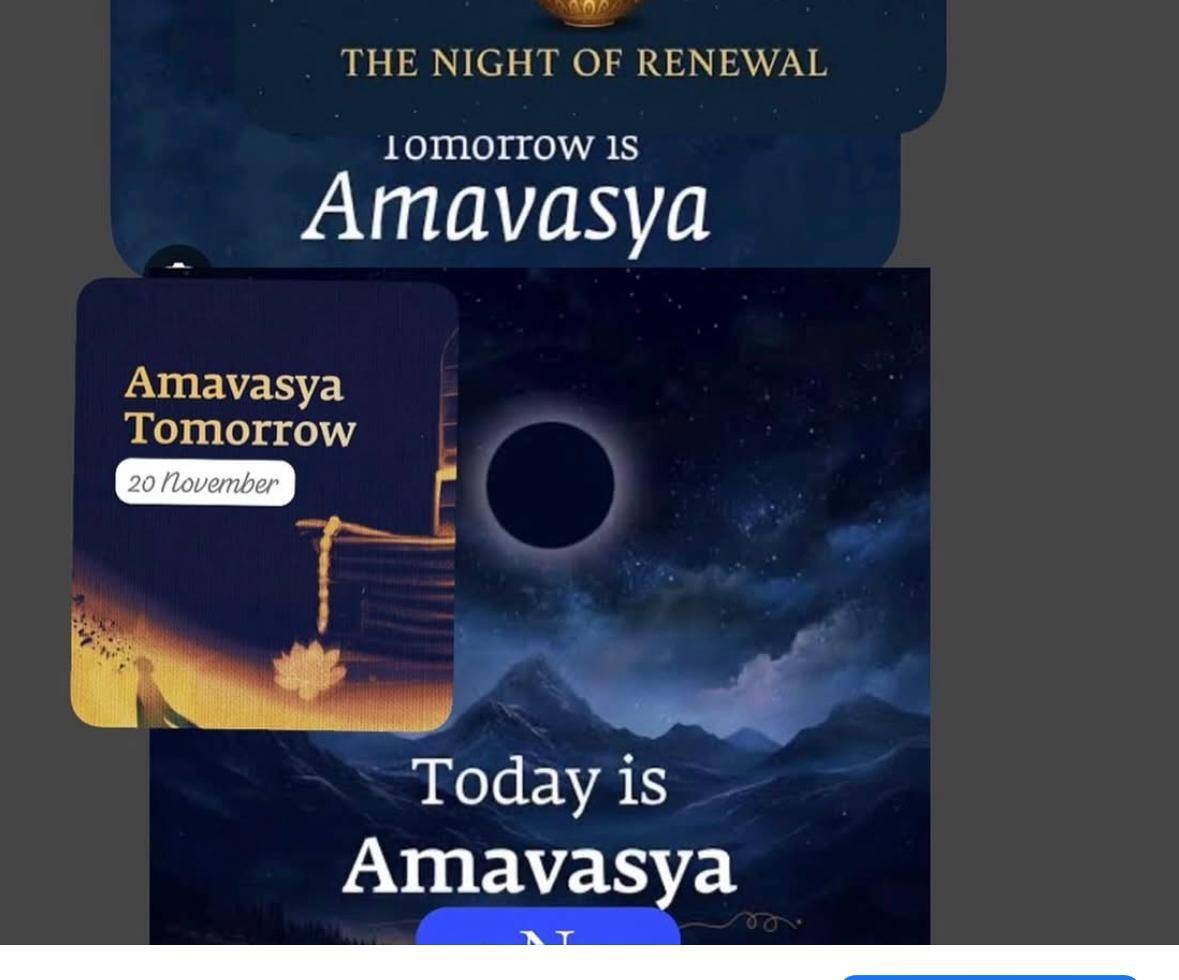
Full Moon and New Moon: The rhythmic cycle of nature’s energy 🔘
The true spiritual principle of Amavasya (New Moon) ⚫️
The Sun is the fundamental source of energy in the universe. When the Sun rises, creation gains momentum; therefore, practices like Surya Namaskar and offering water (Arghya) are considered powerful and beneficial.
At night, this same solar energy is absorbed and reflected by the Moon and reaches us. Hence, Purnima (Full Moon) is a day when lunar energy is at its strongest, and many people consider it auspicious.
— What happens on Amavasya?
On Amavasya, the Moon cannot directly provide energy toward the Earth and Sun because its visible phase disappears.
As a result, lunar energy at night is reduced, and according to traditional understanding, subtle cosmic energy is relatively lower on that day.
Signs in nature:
On that night, subtle changes can be observed in the movement of leaves, animal behavior, ocean tides, and even the feel of water.
A little observation is enough to notice these effects.
In my opinion, on that day the flow of universal energy on Earth slows down slightly, and some sensitive individuals may perceive its impact.
This is not something frightening—it is simply a natural cycle of energy in nature.
Lunar phases, eclipses, and celestial movements:
Lunar phases, eclipses, and planetary alignments all operate on the principle of “absorption and release” of energy (give and take).
The generosity of the Sun, the calmness of the Moon, and the discipline of nature—along with their gentle–intense–gentle rhythm—
if absorbed by humans, then neither Full Moon nor New Moon can cause distress.
Just as daytime energy is strong and nighttime energy is lower, the Moon waxes and wanes—from Amavasya to Purnima 🌕.
Strength increases and decreases accordingly.
Experience: sudden fire incidents during Full Moon / more accidents during New Moon (as observed).
Conclusion:
When a person’s nature is balanced, diet is pure, and mind is stable, then no natural cycle—whether Full Moon or New Moon—disturbs the mind.
Instead, it brings a sense of harmony with nature.